Register Now
Lend a hand to seabirds…in the places where seabird restoration first took flight!
During this adventurous hands-on session, participants will have the unique experience of landing on Eastern Egg Rock where Project Puffin began over 50 years ago. Seasonal researchers live and work on seabird nesting islands, including Eastern Egg Rock, from mid-May until mid-August and then depart when puffins and other seabirds migrate to their winter homes. This is when participants in the Saving Seabirds session offer a hand to Project Puffin, the innovative program that successfully brought puffins and terns back to several Maine islands after extirpation. This session includes projects for many ability levels and the opportunity to learn new skills.
This session includes field trips, workshops, and evening programs that offer opportunities to contribute to seabird conservation through service-based learning. Depending upon safe boating conditions, service projects may include invasive plant removal and marine debris cleanup on Eastern Egg Rock. Other projects may include painting seabird decoys and building observation blinds and shelters for seabird chicks.
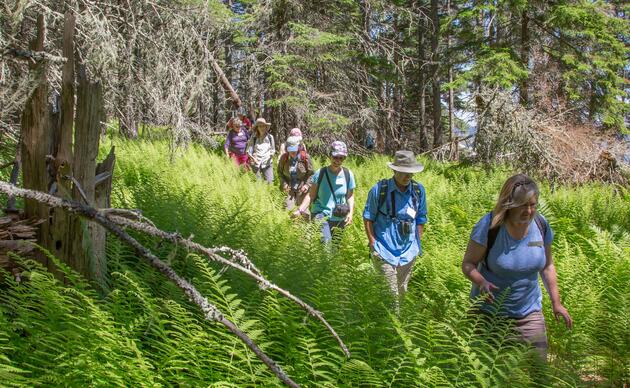
Back on Hog Island, participants will discover the island’s history, learn about seabird identification, adaptations and migration, and explore Hog Island’s moss-carpeted spruce forests. Throughout the session, participants will learn from and work alongside expert bird biologists, educators, and leaders in seabird conservation.
Pricing: $695
The base registration fee includes meals, housing, instruction, and all field trips. This price is based on a standard shared room (with 2 twin beds) a shared bathroom. A limited number of upgraded accommodations are available for an additional cost. Two upgrade options are a single room for solo travelers or a room with a private bath for two people traveling together. There are no single rooms with private bathrooms available. Please see our lodging page for more information.
Participants must arrange their own transportation to and from the Audubon dock in Bremen at the start and end of the session. Please see our transportation page for more information.
There are several scholarship opportunities available to help participants attend Hog Island sessions! Please see our scholarships page for more information about Hog Island Scholarships. You should also check with your local Audubon chapter or bird club for additional opportunities.
Requirements: There are no prerequisites for this program! Landing on a seabird island requires participants to transfer from a tour vessel, to a dory, to the rocky shore in dynamic conditions. There is no dock and participants must be able to navigate boulders, slippery rockweed, and narrow, uneven trails to access the island. A degree of physical mobility is required. This activity can be hazardous and participation is at your own risk. Participants are not required to go ashore and may stay on the boat.
Birders of all skill levels are welcome as are less experienced/enthusiastic partners, friends, or family.
Director: Maggie Dewane
Maggie Dewane first visited Hog Island in 2002 as a camper for youth ecology camp and has since returned over the years as both camper and instructor, always drawn to this magical place. Now she joins us as camp director to the Birds of Maine Islands session, sharing insight as a climate and wildlife journalist and filmmaker.
Maggie is the Communications Director to Defenders of Wildlife and serves on the board of Birdability, a nonprofit dedicated to increasing accessibility to the outdoors through birding. She co-hosts a wildlife podcast, The Watering Hole, and sits on the DC Environmental Film Festival Advisory Council. She has a B.S. in diplomacy and international relations from Seton Hall University and an MPA in environmental science and policy from Columbia University. In her free time, Maggie is hiking with her dog Argos, playing soccer, or eating the delicious food found on Hog Island.
Instructors: Steve Kress, "Seabird Sue" Schubel, Keenan Yakola
Steve Kress is the Founder of Project Puffin, and was Executive Director of the Seabird Restoration Program and Vice President for Bird Conservation of the National Audubon Society for many years. He received his B. S. in Zoology and M.S. in Wildlife Management from Ohio State University, and his Ph.D. in Environmental Education from Cornell University. Steve began Project Puffin in 1973 and served as the Director from then until 2019, when he retired. Steve has also served as Manager of National Audubon's Maine Coastal Island Sanctuaries, Ornithology Instructor at the Audubon Camp in Maine on Hog Island from 1969 through 1981, and Director of the camp from 1982 through 1986 (as well as serving as Director once again just before his retirement). Prior to working for Audubon, he was Assistant Director of the Glen Helen Outdoor Education Center in Yellow Springs, OH, where he taught Field Ornithology and founded the Glen Helen Raptor Rehabilitation Center. Steve was formerly a Visiting Fellow for the Cornell Lab of Ornithology in Ithaca, NY, where he taught a popular birding course called Spring Field Ornithology for many years. Steve continues to teach a Spring Ornithology course, and it is now available via the Cayuga Bird Club.
"Seabird Sue" Schubel is Project Puffin's own Disney Hero , and has been the Outreach Educator for Project Puffin since 2000. She loves to engage her students in exciting learning activities and share real data from the seabird islands with them. Her acquaintance with Project Puffin began in high school, when she saw Marlin Perkins rowing ashore with Steve on Mutual of Omaha's Wild Kingdom episode Return of the Puffin. She started working with Project Puffin as a volunteer on Matinicus Rock in 1984, and since then has spent many summers on islands in Maine,California and the Galapagos. Sue loves islands and beasts, and once acquired a dog with very familiar little black triangles over its eyes.
Keenan Yakola's coastal upbringing on Cape Cod, MA sparked a deep love for the ocean and New England coast. The earliest birding experiences he can recall from his childhood included watching Common Terns plunge dive for fish and Common Eider ducklings bravely tackling the waves crashing along Maine's rocky coastline. These experiences formed the foundation for his interest in birding and eventually the focus of his academic research.
Keenan has worked with the National Audubon Seabird Institute for over a decade. During this time he has worked as a research assistant on Eastern Egg Rock, served as the supervisor of Seal Island National Wildlife Refuge, completed his Master's degree focused on long-term dietary shifts in some of Maine's iconic seabirds, and now is pursuing his PhD studying the movement ecology of terns and petrels using GPS tracking devices here in Maine. While Keenan's research interests focus on the conservation of seabirds, he is passionate and curious about any bird he can put his binoculars on!
NOTE: Audubon reserves the right to alter itineraries, instructors and particular arrangements, or to substitute similar itineraries or arrangements, at no penalty. If Audubon cancels a session, it will issue full refunds of all deposits or payments to the paid participants.
Landing on Eastern Egg Rock is weather dependent and not guaranteed. Eastern Egg Rock is located approximately six miles offshore and is exposed to marine conditions. Windy weather and the motion of the ocean cannot be controlled. Participant safety is our highest priority and Audubon’s decision on whether to land is final.
If landing is deemed unsafe, participants will still visit Eastern Egg Rock and view seabirds from the vessel which provides a closer view than standard puffin cruises. Further, participants will learn more about the history and geology of Muscongus Bay while visiting other, nearby islands.
How you can help, right now